

A lot has been written and said about motivation.
Here we will consider why, despite good plans and best intentions, we cannot achieve our goals.
Why sometimes after a wave of enthusiasm comes decline and stagnation.
What is worth knowing about motivation and what influences it?
Maslow's pyramid of needs
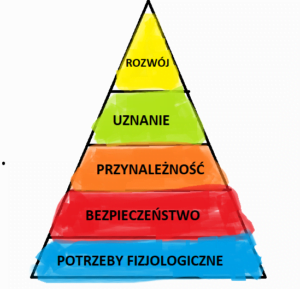
According to Maslow's pyramid of needs the most important for a person are physiological needs, i.e. those related to the functioning of his body. As primary needs, they allow humans to survive in the environment. Biological needs include not only breathing or eating, but also sleep, which regenerates our body, as well as the need for reproduction, and simply decent living conditions. If these cardinal needs are not met, we cannot talk about meeting other needs, such as the need for security. Nowadays, it is identified mainly with the security provided by a permanent source of income: work, stable financial and housing situation.
The next need is belonging and acceptance. These are friends, acquaintances, colleagues from work - that is, the level of relationships that are seriously failing today. Lack of acceptance can effectively hinder the building of self-esteem, which it represents, among others: level of recognition - i.e. a strong need to be appreciated by others. At the end of the pyramid is the need for self-fulfillment and development. According to Maslow, it is possible only after achieving stabilization in all previous ones.
Maslow's pyramid of needs perfectly explains the failures of some motivational systems operating in organizations when the focus is on the development of employees through numerous training courses and high goals, thus paying very low wages, or situations in which the bar is raised (development), without showing appreciation for the work and employee involvement.
You cannot count on success in achieving your goals when there is a lack of biological resources (e.g. lack of sleep causing a failed exam or poor presentation at work), or poor academic performance of a child who grows up in an alcoholic family (the need for a sense of security is not ensured).
Therefore, if something does not work, it is worth considering whether there is a deficit in satisfying a lower-level need.
FROM and TO motivation - i.e. internal and external motivation
“Do” motivation refers to actions we undertake of our own free will because they are satisfying, interesting, or consistent with our values and goals. It is motivation that comes from within us and is not related to external rewards. Examples of "do" motivation include:
- Learning a new language because it's fun.
- Physical exercise because it makes us feel better.
- Implementation of a project that is consistent with our passions and interests.
Motivation “from” (external motivation)
“From” motivation refers to the actions we take to avoid negative consequences, penalties or unpleasant situations. It is a motivation based on fear, pressure or external coercion. Examples of "from" motivation include:
- Working on a task to avoid criticism from your boss.
- Studying for the exam so as not to fail the subject.
- Cleaning the house to avoid arguments with your roommate.
Differences between "to" motivation and "from" motivation
- A source of motivation: Motivation "to" comes from within, while motivation "from" is related to external factors.
- Direction of action: The "do" motivation is positive and leads to action that brings us joy or satisfaction. The “from” motivation is negative and related to avoiding unpleasantness.
- Durability: The "do" motivation is usually more lasting because it is related to our internal values and goals. “From” motivation may be less sustainable because it relies on external pressures that may change.
The differences in FROM and TO motivation are perfectly illustrated in the figure below:

For years, it has been believed that DO motivation has a more beneficial effect on people, e.g. the promise of a bonus after completing a task, or the promise of buying a trampoline after receiving a certificate with a belt. Meanwhile, the results of scientific research have clearly shown that we are more motivated by the prospect of losing what we already have (e.g. if we do not achieve the planned sales level, we will be fired).
It is worth asking ourselves: what will we lose if we don't do it, rather than what will we gain.
The influence of dopamine on motivation. What is its relationship to motivation?
Dopamine plays a key role in controlling the motivation process - in learning what things in the world are good and what are bad, and in choosing actions that will obtain good things and avoid bad things. It is transmitted by dopamine neurons in two modes: "tonic" and "phasic"
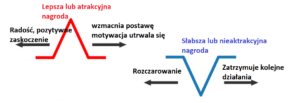
In the tonic mode, neurons responsible for the production of dopamine maintain its constant level (this situation is indifferent to us, it neither motivates us nor discourages us)
In a phasic mode, dopamine neurons rapidly increase or decrease their amount, a phenomenon known as a dopamine burst or burst. This state is a signal to our body that the reward is attractive or not, which strengthens our resolution or ruins our motivation.
The type of reward (how attractive it is and whether we expect it) affects the strength of the dopamine burst. Thus, the lack of a reward, or a reward that is weaker than expected, causes a decrease in motivation, an attractive reward affects the intensity of the dopamine release (a strong dopamine release connects a larger number of neurons, which enhances synaptic plasticity, i.e. the behavior becomes permanent)
How do dopamine neurons learn to predict reward?
Classic theories suggest that we learn to predict rewards through a gradual process of reinforcement, i.e. the reward should be attractive and repeated.
What influences motivation?
- To motivate us, the reward should be attractive and come as quickly as possible. It is worth setting intermediate rewards or dividing tasks into smaller parts and rewarding each of these parts.
- The appetite for reward increases as we eat, which means that we will want to receive more and more attractive rewards (more often and more)
- We need to take care of the lower-level needs and make sure that they have been met to a significant extent, and their absence does not prevent us from achieving higher-level goals.
- We are more motivated by the prospect of losing what we already have than by the promise of reward. This is the so-called OD motivation.
 English
  Polish