

In recent years, neuroleadership has become increasingly popular as a modern approach to developing managerial competencies. For some, it sounds like just another trendy HR term; for others, it sounds like a real response to the challenges facing modern leaders: overload, stress, change, declining engagement, communication difficulties, and the growing need to build trust within teams.
So how does neuroleadership differ from traditional management? Is it a completely new approach, or is it a deepening of already established managerial competencies?
Neuroleadership does not replace management, but shows it from a deeper perspective – through the prism of how a person actually thinks, reacts, makes decisions, learns, cooperates and defends themselves against threats.
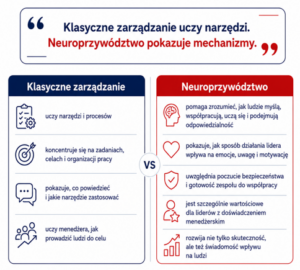
Classic management teaches tools. Neuroleadership reveals mechanisms.
Typical management training focuses on what a leader should do. It teaches delegation, motivation, providing feedback, enforcing goals, conducting difficult conversations, resolving conflicts, and managing change.
These are crucial competencies. The problem, however, is that simply knowing the tools isn't always enough. A manager might be familiar with the feedback model, yet their conversation with an employee still ends in resistance. They might communicate change well, yet the team still reacts with uncertainty. They might clearly delegate a task, yet the employee still avoids responsibility.
Neuroleadership therefore asks an additional question: what is happening „underneath”?
What triggers a defensive reaction in a person? Why do some people shut themselves off from feedback? Why is change so resistant, even when rationally justified? How does stress influence a leader's decisions? What makes employees feel safe, engaged, and ready to collaborate? And this is where neuroleadership begins.
A human being is not just an "employee." He is a nervous system in relationship.
In traditional management, we often view people through the lens of roles: employee, specialist, leader, team member, and result-driver. Neuroleadership reminds us that behind every role is a human being with emotions, needs, experiences, beliefs, and a nervous system that constantly scans the environment for safety or threat.
This means that people don't just react rationally to a leader's messages. They also respond to tone of voice, questioning, level of control, sense of fairness, predictability of the situation, ability to influence, and the quality of the relationship.
The same message can be perceived as supportive or threatening. The same change can be perceived as an opportunity or a loss of control. The same feedback can trigger reflection or defense.
Therefore, in neuroleadership, a leader is not only someone who plans, delegates, and holds people accountable. They are also someone who influences people's levels of tension, safety, trust, and readiness to act.
The leader as a voltage regulator in the team
One of the most interesting differences between classical management and neuroleadership is the way of understanding the role of a leader.
Traditionally, a leader is responsible for organizing work, setting goals, monitoring results, motivating, and holding people accountable. In neuroleadership, the leader also regulates tension within the team. This means that their communication style can either reduce tension and strengthen cooperation, or trigger defensive reactions.
An example? Imagine an employee who has made a mistake. Classic management suggests: conduct a corrective conversation, name the problem, establish expectations, and discuss the consequences. Neuroleadership adds: do this in a way that doesn't trigger excessive shame, fear of judgment, a sense of status loss, or the need to defend oneself.
This isn't about abandoning expectations. It's about setting expectations in a way that increases opportunities for reflection, accountability, and behavioral change.
Feedback can build development or trigger defense.
Feedback is one of a manager's fundamental tools. However, every leader knows that feedback doesn't always work as intended. Sometimes an employee makes excuses, attacks, withdraws, falls silent, or seemingly agrees, and then nothing changes.
From a neuroleadership perspective, feedback isn't just a message. It's a social stimulus that can be perceived as a signal of safety or threat.
If an employee experiences feedback as an attack on their value, competence, or position in the team, they may enter a defensive mode. Their ability to listen, learn, and seek solutions significantly diminishes. Instead of reflection, they choose to fight, flee, freeze, or rationalize.
Neuroleadership doesn't say, "Don't give difficult feedback." On the contrary, it shows how to do it more effectively. How to separate the person from the behavior. How to foster a sense of influence. How to ask questions that trigger thinking, not defense. How to build a conversation in which responsibility doesn't have to mean threat.
Motivation is not just about goals and rewards
In traditional management, motivation is often linked to goals, bonuses, development, praise, promotion, or management style. Neuroleadership demonstrates that motivation is much more complex, as people engage not only when they have a clearly defined goal. They engage when they see meaning, feel influential, experience fair treatment, feel part of a team, and know what to expect.
The SCARF model, often used in neuroleadership, is very helpful here. It describes five important social areas that influence our responses at work:
- Status — that is, a sense of self-worth, competence and position.
- Certainty — that is, predictability, clarity and the feeling that I know what is happening.
- Autonomy — that is, autonomy, influence and choice.
- Relatedness — that is, relationality, trust and a sense of belonging.
- Fairness — that is, justice, transparency and fairness of rules.
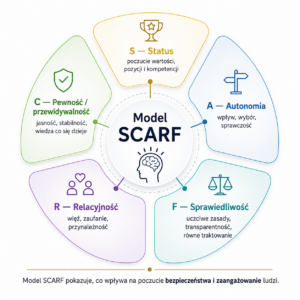
When these areas are strengthened, people are more likely to respond with openness, cooperation, and engagement. If they are threatened, resistance, tension, distance, or a decrease in motivation may occur.
Resistance to change does not always mean bad faith
One of the most important applications of neuroleadership is change management. In organizations, we often say that people "resist change." While this is true, it's worth asking: what exactly are they resisting?
Sometimes it's not about the change itself. It's about uncertainty. A lack of influence. Communication chaos. Fear of losing competence. A sense of injustice. Information overload. The fear that previous experience will no longer matter.
Classic change management focuses on communication, the implementation plan, process steps, and the role of leaders. Neuroleadership adds a human-response perspective: how the brain responds to uncertainty, loss of control, and cognitive overload.
Therefore, a change leader should not only explain what is changing. They should also increase predictability, give people real influence where possible, explain the rationale behind decisions, foster a sense of fairness, and distribute information in a way that doesn't overwhelm.
A leader's brain also works under pressure
Neuroleadership isn't just about employees. It's also about the leader themselves.
A manager under pressure can also be reactive. They may shorten their messages, lose patience, make judgments more quickly, limit listening, become overly controlling, or avoid difficult conversations. Stress narrows perception and hinders access to reflective, flexible action.
Therefore, developing a leader in the spirit of neuroleadership encompasses not only management tools but also self-awareness and self-regulation. Leaders learn to recognize their own automatisms, cognitive biases, emotional reactions, and ways of functioning under pressure.
This is very practical. Because a leader who cannot regulate himself will have difficulty regulating tension in the team.
Trust is not a "soft perk"„
In many organizations, trust is treated as a value. Something important, but sometimes vague. Neuroleadership demonstrates that trust has a very practical dimension.
Where trust is low, people expend more energy protecting themselves. They consider what to say, what to withhold, how to protect their position, and how to avoid blame. In such an environment, collaboration, creativity, accountability, and learning from mistakes are more difficult.
Where trust is higher, people are more likely to ask for help, share information, report problems, accept feedback and take initiative.
From a neuroleadership perspective, trust is not just a pleasant atmosphere. It is a prerequisite for effective cognitive and social work.
Neuroleadership should not be a "brain fad"„
However, it's worth being reasonable. Neuroleadership shouldn't mean explaining every human behavior in terms of neurons, hormones, and brain structures. In the business world, it's easy to oversimplify and use catchphrases that sound scientific but contribute little to a leader's practical experience.
Good neuroleadership isn't a brain-based trivia show. It's a practical blend of neuroscience, cognitive psychology, social psychology, and managerial experience.
The greatest value of this approach lies not in the word "neuro" itself, but in a shift in how we view people. Leaders begin to better understand why certain actions work while others provoke resistance. They see that communication, feedback, change, trust, and motivation are not just "soft topics" but real processes that impact work effectiveness.
Neuroleadership Training – Who Is It Really For?
In our training, we see that neuroleadership isn't a topic for every team or every leader at the same stage of development. This isn't a basic management course where participants learn the role of a manager, how to delegate tasks, or how to conduct a conversation with an employee.
Neuroleadership training is more of a next-level, more advanced level of leadership development. It's designed for those who already have management experience, are familiar with basic management tools, and want to better understand why people react the way they do—especially under pressure, change, conflict, feedback, or uncertainty.
This is a proposal for leaders who seek not simple formulas but a deeper understanding of the people in the organization. For those who want to consciously influence the atmosphere, engagement, responsibility, and willingness of their team to collaborate. For managers who understand that effective leadership is no longer just about issuing orders and holding results accountable, but about creating an environment in which people can think, learn, communicate, and act without excessive anxiety, chaos, or a sense of threat.
That is why neuroleadership training is particularly well-suited to experienced managers, executives, HR Business Partners, change leaders, people responsible for organizational culture, and management teams who want to reach a higher level of working with people.
This isn't a training course about "fashionable brains." It's a training course about how to better understand people—and thus guide people more wisely, calmly, and effectively through the challenges of today's organizations.
We invite you to our neuroleadership training.
 English
  Polish